
Reverse Coding Likert Items: Formula, Real Data, Results and Software Workflows
Reverse Coding Likert Items is a complete worked analysis of how Dalc and Walc can be aligned with positively worded 1–5 items while preserving range and respondent order using Dalc and Walc transformed by 6 − x. Within Reverse Coding Likert Items, the 649-record example connects the exact formula to the observed values, diagnostic figures, and reproducible Python, R, SPSS and Excel calculations.
All 649 rows retain the 1–5 range and satisfy x + xR = 6; original 1 becomes 5, 2 becomes 4, 3 stays 3, 4 becomes 2 and 5 becomes 1
The worked Reverse Coding Likert Items analysis is restricted to Dalc_R and Walc_R. It uses Dalc and Walc transformed by 6 − x and reaches this reportable conclusion: All 649 rows retain the 1–5 range and satisfy x + xR = 6; original 1 becomes 5, 2 becomes 4, 3 stays 3, 4 becomes 2 and 5 becomes 1. Within Reverse Coding Likert Items, that wording is deliberately narrower than a general claim about all survey constructs, all groups or all possible models.
What Reverse Coding Likert Items measures
The exact statistical or data-management question is isolated from neighboring methods.
Reverse Coding Likert Items addresses how Dalc and Walc can be aligned with positively worded 1–5 items while preserving range and respondent order. Its target is Dalc_R and Walc_R, not a general claim about every variable in the source file.
Defined target
Within Reverse Coding Likert Items, the analysis treats Dalc and Walc transformed by 6 − x as the complete variable ledger. This ledger fixes the unit of analysis, group order, score direction and denominator. The central result is All 649 rows retain the 1–5 range and satisfy x + xR = 6; original 1 becomes 5, 2 becomes 4, 3 stays 3, 4 becomes 2 and 5 becomes 1.
Reverse-key scoring transformation is appropriate only for this defined target. The article does not relabel label reversal, z-score sign change or manual find-and-replace as the same procedure.
What is not being claimed
Reverse Coding Likert Items does not establish causation, universal validity or invariance across unobserved populations. The evidence belongs to the 649-record dataset and the declared coding. Its interpretation is conditioned on known intended direction, valid source range, no recode of missing sentinel as score and original variables preserved.
The post therefore reports reverse key, mapping table and range preservation before extending the result. This sequence prevents a software label from becoming a broader scientific conclusion.
Reverse Coding Likert Items data and variable ledger
Every number is tied to a named source field or declared derived field.
Analysis population and source structure
For Reverse Coding Likert Items, the working source contains 649 records and 33 variables, while the operative fields are Dalc and Walc transformed by 6 − x. Within Reverse Coding Likert Items, the original row identity is retained so software outputs, charts and the Excel workbook can be reconciled record by record.
| Ledger element | Applied definition | Release control |
|---|---|---|
| Checkpoint 1 | lower bound = 1 | For Reverse Coding Likert Items, checkpoint 1 must agree across the article, its assigned chart, the software report and the workbook. |
| Checkpoint 2 | upper bound = 5 | For Reverse Coding Likert Items, checkpoint 2 must agree across the article, its assigned chart, the software report and the workbook. |
| Checkpoint 3 | constant = 6 | For Reverse Coding Likert Items, checkpoint 3 must agree across the article, its assigned chart, the software report and the workbook. |
| Checkpoint 4 | 649 row-level validation checks | For Reverse Coding Likert Items, checkpoint 4 must agree across the article, its assigned chart, the software report and the workbook. |
| Question | how Dalc and Walc can be aligned with positively worded 1–5 items while preserving range and respondent order | Cannot be broadened after seeing the p-value or graphic. |
| Outcome | Dalc_R and Walc_R | Units and category order remain explicit. |
Research design and estimand for Reverse Coding Likert Items
Within Reverse Coding Likert Items, the procedure follows the design rather than choosing a method from the appearance of a chart.
Unit of analysis
One source row is one respondent record for Dalc_R and Walc_R; no row is silently duplicated across this analysis.
Estimand
The estimand asks how Dalc and Walc can be aligned with positively worded 1–5 items while preserving range and respondent order.
Primary output
The primary output is stated as All 649 rows retain the 1–5 range and satisfy x + xR = 6; original 1 becomes 5, 2 becomes 4, 3 stays 3, 4 becomes 2 and 5 becomes 1.
Scale meaning
Dalc_R and Walc_R is interpreted in its declared unit and order.
Software agreement
Python, R, SPSS and Excel must use the same rows, coding and reverse-key scoring transformation formula.
Decision rule
Magnitude, precision, assumptions and diagnostics for Dalc_R and Walc_R are considered together; a p-value is never the entire conclusion.
Reverse Coding Likert Items assumptions and failure consequences
Each condition is connected to a specific change in interpretation.
Known intended direction
If known intended direction fails, the stated reverse-key scoring transformation interpretation may no longer identify Dalc_R and Walc_R.
Valid source range
The software can still return output when valid source range is false, so this condition is checked independently.
No recode of missing sentinel as score
The article narrows its language or redirects analysis to manual find-and-replace when no recode of missing sentinel as score is not defensible.
Original variables preserved
The assigned charts are reviewed for evidence relevant to original variables preserved before publication.
Reverse Coding Likert Items formulas in native MathML
Fractions, roots, sums, subscripts and superscripts are rendered without external libraries.
The equations below belong to reverse-key scoring transformation and the declared Dalc_R and Walc_R. Symbols are defined in the surrounding text and numerical substitution remains tied to Dalc and Walc transformed by 6 − x.
Within Reverse Coding Likert Items, for a bounded item, reverse scoring subtracts the observed response from the sum of the endpoints.
Within Reverse Coding Likert Items, the arithmetic mean is reported only when its numerical spacing interpretation is made explicit.
Within Reverse Coding Likert Items, sample variance uses the n−1 denominator and describes dispersion in the stated score unit.
The interquartile range summarizes the middle half of an ordered response distribution.
Overall completeness is one minus the proportion of expected cells coded as missing.
Worked Reverse Coding Likert Items calculation
The result is reconstructed from its actual variables and checkpoints.
Freeze the analysis set
Retain the rows required for Dalc and Walc transformed by 6 − x and record the denominator.
Apply coding rules
Validate range, direction, category order and derived fields for Dalc_R and Walc_R.
Compute the statistic
Use the displayed reverse-key scoring transformation formula rather than a similarly named procedure.
Reconcile software
Compare Python, R, SPSS and Excel outputs at full precision.
Write the conclusion
Report All 649 rows retain the 1–5 range and satisfy x + xR = 6; original 1 becomes 5, 2 becomes 4, 3 stays 3, 4 becomes 2 and 5 becomes 1 with its assumptions and limitations.
| Calculation checkpoint | Verified content | Interpretive role |
|---|---|---|
| 1 | lower bound = 1 | reverse key must agree across all outputs. |
| 2 | upper bound = 5 | mapping table must agree across all outputs. |
| 3 | constant = 6 | range preservation must agree across all outputs. |
| 4 | 649 row-level validation checks | direction alignment must agree across all outputs. |
Verified Reverse Coding Likert Items result
The numerical result is stated before broader discussion.
Primary finding
reverse-key scoring transformation
For the primary release decision, All 649 rows retain the 1–5 range and satisfy x + xR = 6; original 1 becomes 5, 2 becomes 4, 3 stays 3, 4 becomes 2 and 5 becomes 1.
Five assigned Reverse Coding Likert Items charts
Within Reverse Coding Likert Items, the first chart is full width; the remaining figures are paired as in the supplied sample.
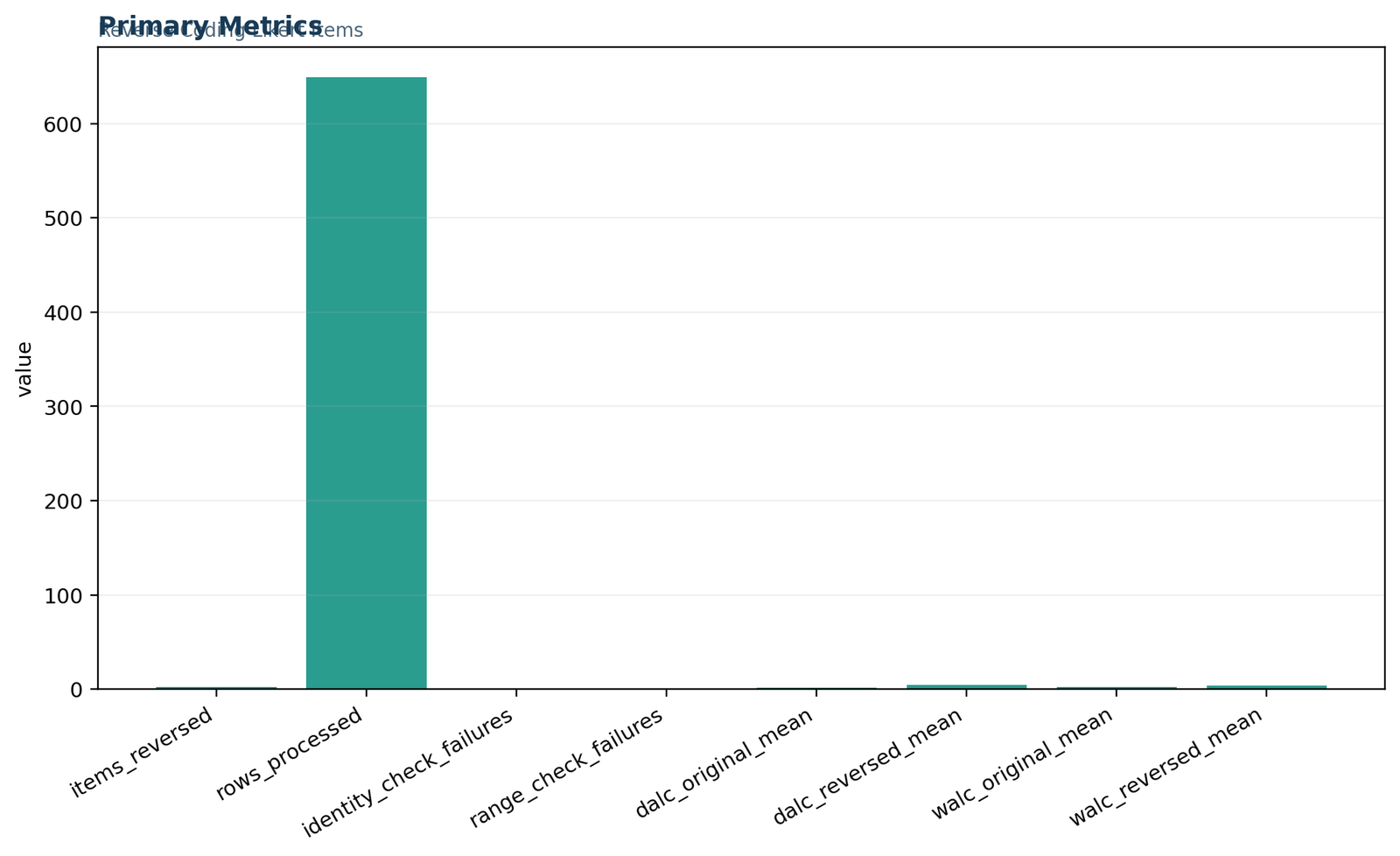
Primary reverse-coding metrics
The Primary reverse-coding metrics panel opens the evidence sequence for reverse-key scoring transformation. It anchors reverse key to lower bound = 1 and to Dalc and Walc transformed by 6 − x. Within Primary reverse-coding metrics, because the estimand is Dalc_R and Walc_R, the figure is interpreted only as evidence about how Dalc and Walc can be aligned with positively worded 1–5 items while preserving range and respondent order. Within Reverse Coding Likert Items, its row count, coding direction and denominator must agree with the result table before the visual pattern is released.
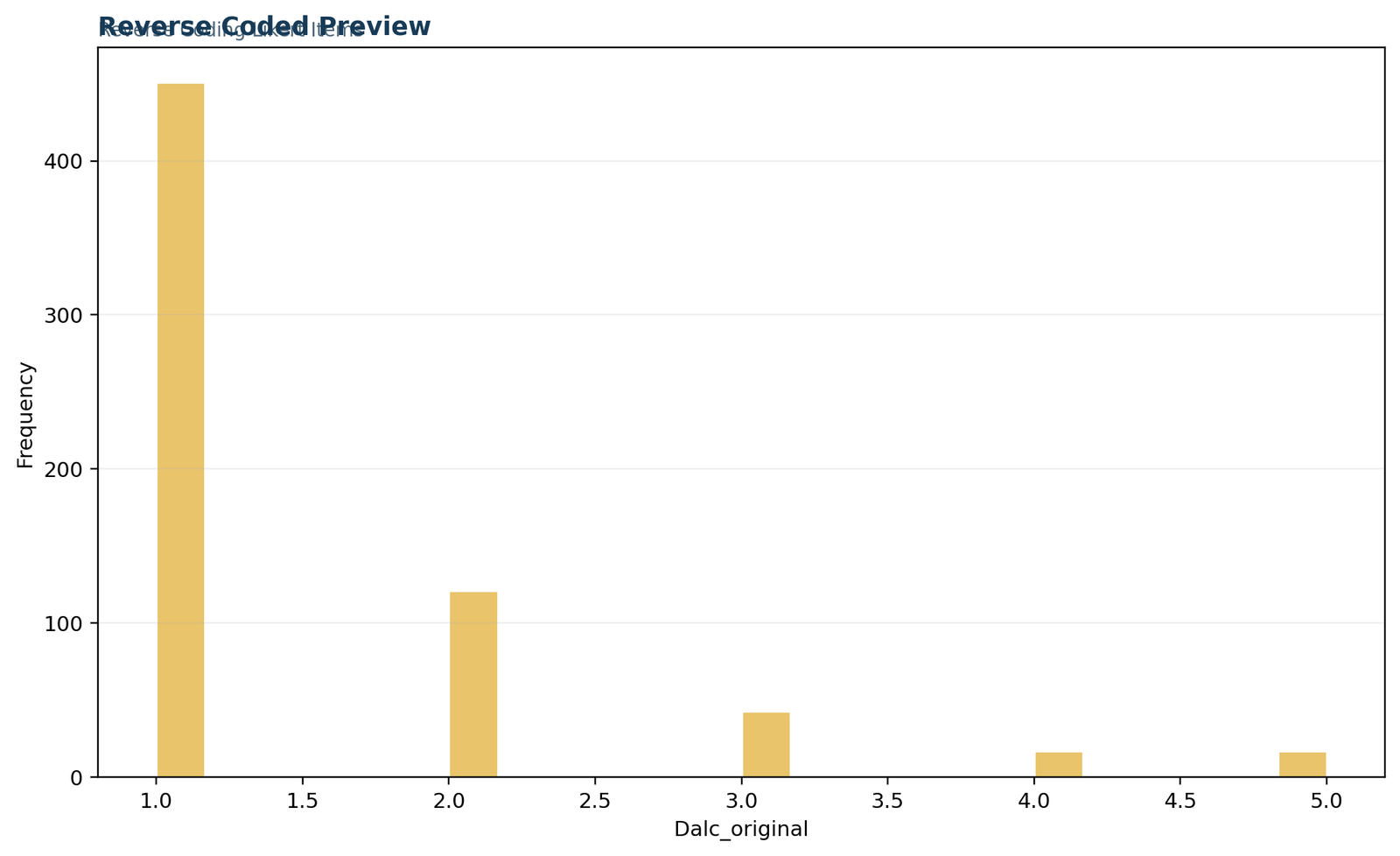
Original-to-reversed mapping
In the second figure, Original-to-reversed mapping isolates mapping table. The plotted values must reproduce upper bound = 5 from Dalc and Walc transformed by 6 − x; otherwise the image belongs to a different filter or coding version. The Original-to-reversed mapping display supports Dalc_R and Walc_R without converting the chapter into a broader claim about unrelated survey fields.
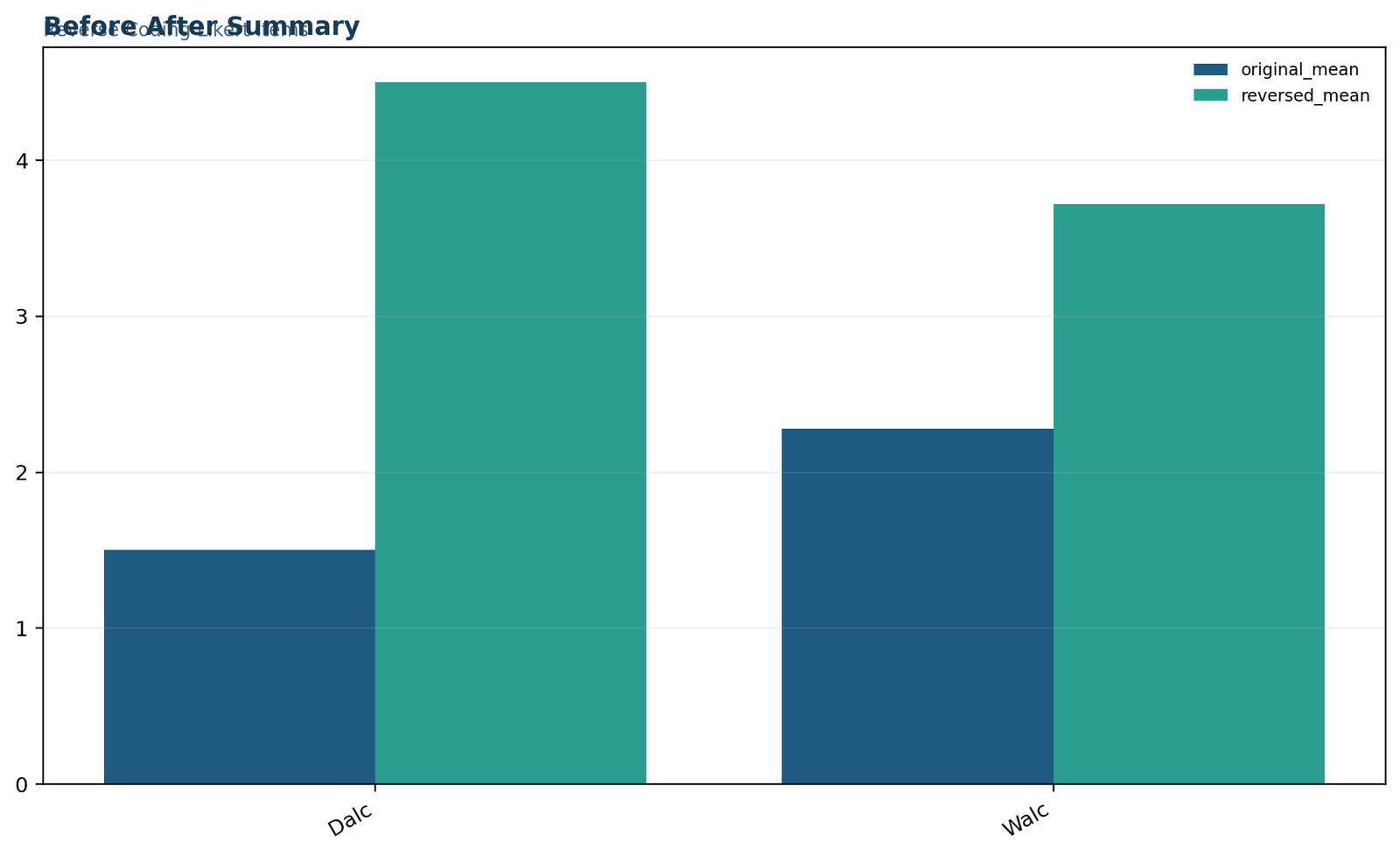
Dalc validation profile
The Dalc validation profile graphic supplies the third numerical cross-check. For this reverse-key scoring transformation, range preservation is read together with constant = 6, the declared group or item order, and the 649-record denominator. A visually strong pattern cannot override a contradictory table, formula or software object.
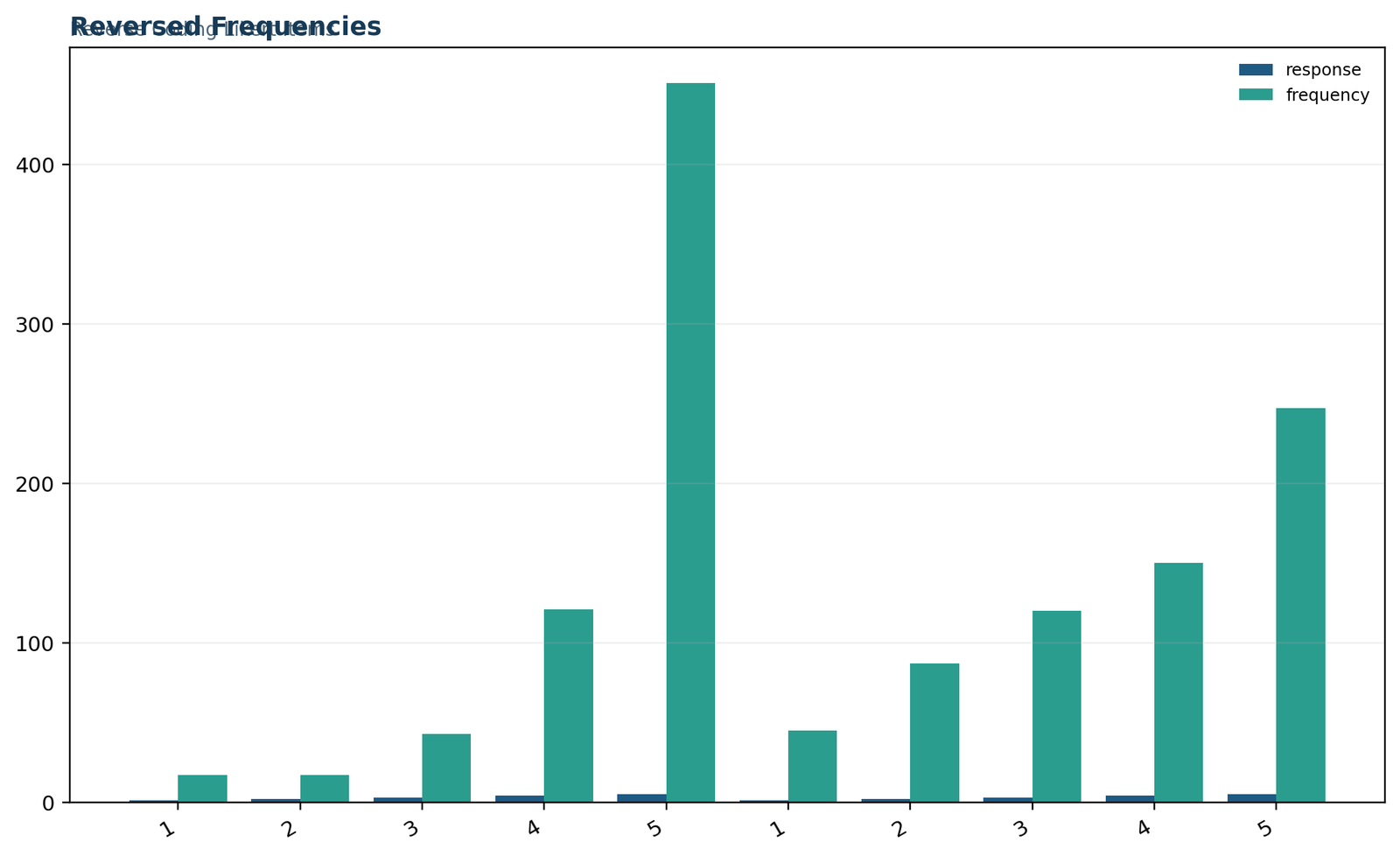
Walc validation profile
Figure four, Walc validation profile, focuses on direction alignment as a diagnostic rather than decoration. It must preserve Dalc and Walc transformed by 6 − x and remain consistent with 649 row-level validation checks. Within Reverse Coding Likert Items, if its categories, score direction or sample differ, the caption is withheld until the asset and analysis ledger are reconciled.
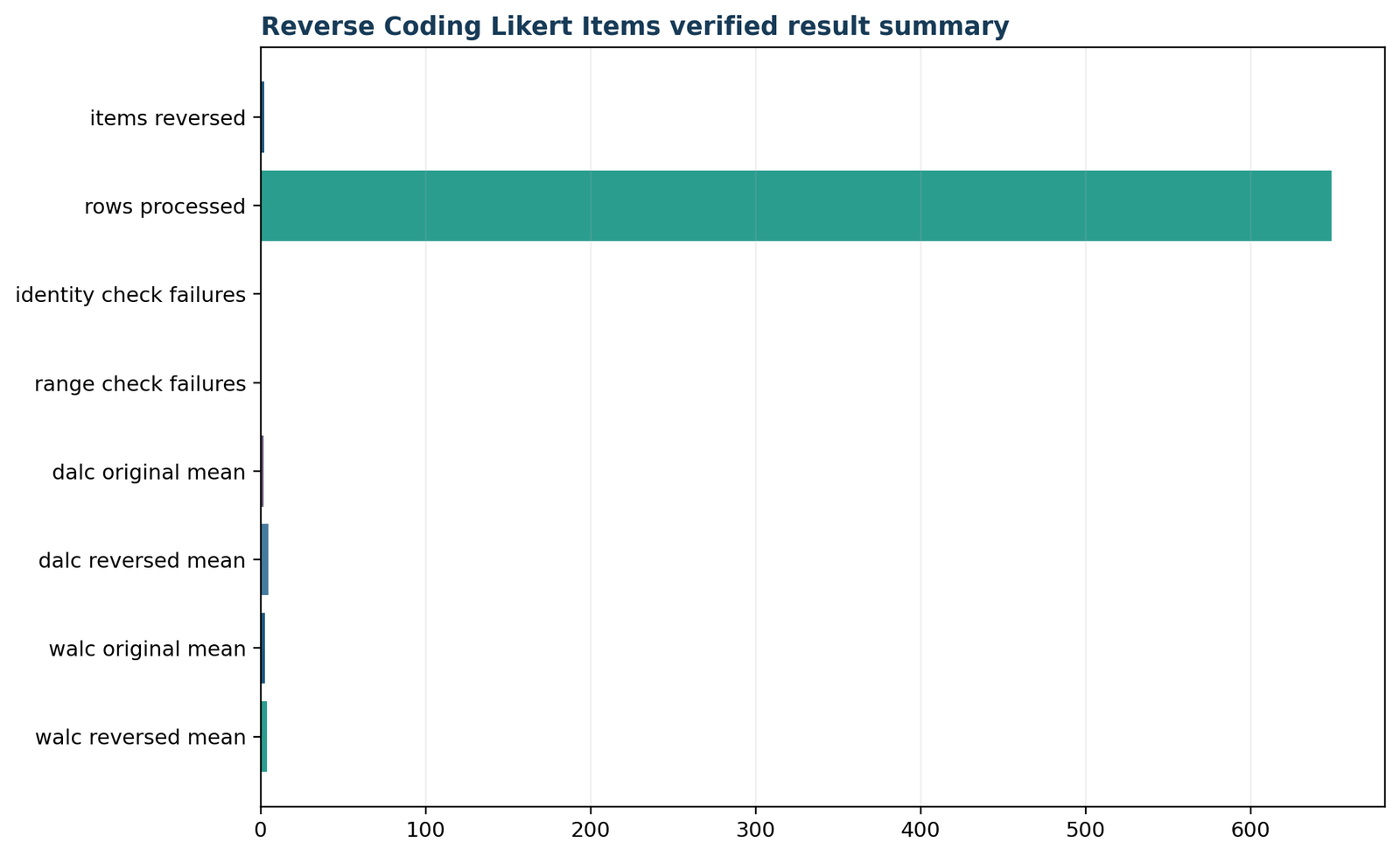
Verified reverse-coding summary
The closing Verified reverse-coding summary panel consolidates the worked result for Dalc_R and Walc_R. It is accepted only when the displayed audit identity, lower bound = 1, and the independent Python, R, SPSS and Excel outputs agree. The summary does not widen the estimand beyond how Dalc and Walc can be aligned with positively worded 1–5 items while preserving range and respondent order.
Reverse Coding Likert Items in Python
The Python workflow computes the defined result and asserts the source structure.
Reverse Coding Likert Items in Python starts from the original semicolon-delimited file and creates a dedicated object for Dalc_R and Walc_R. It does not reuse a filtered object from another analysis. Assertions check the 649-row denominator, field ranges and the specific values needed for reverse-key scoring transformation.
import pandas as pd

df = pd.read_csv("student-por.csv", sep=";")

for source in ["Dalc","Walc"]:

target = source + "_R"

df[target] = 6 - df[source]

assert df[target].between(1,5).all()

assert (df[source] + df[target]).eq(6).all()

print(df[["Dalc","Dalc_R","Walc","Walc_R"]].head())
The expected Python interpretation is All 649 rows retain the 1–5 range and satisfy x + xR = 6; original 1 becomes 5, 2 becomes 4, 3 stays 3, 4 becomes 2 and 5 becomes 1. Within Reverse Coding Likert Items, printed values are retained at full precision before the article rounds them, and every chart label is checked against the same result object.
Reverse Coding Likert Items in R
The R reconstruction uses explicit factors, complete-case rules and named result objects.
The R section independently rebuilds Dalc_R and Walc_R. Character categories are converted only where the method requires factors or ordered responses, and the formula is checked against lower bound = 1. Within Reverse Coding Likert Items, r output is not assumed to match merely because the displayed p-value rounds to the same three decimals.
d <- read.csv("student-por.csv", sep=";")

d$Dalc_R <- 6-d$Dalc; d$Walc_R <- 6-d$Walc

stopifnot(all(d$Dalc+d$Dalc_R==6),all(d$Walc+d$Walc_R==6))

head(d[c("Dalc","Dalc_R","Walc","Walc_R")])
For Reverse Coding Likert Items, the R object, printed table and assigned PDF must retain the same row count, group order and variable direction as Python and Excel.
Reverse Coding Likert Items in SPSS
SPSS syntax and output are kept specific to the declared method.
The SPSS workflow assigns appropriate nominal, ordinal or scale measurement levels before running reverse-key scoring transformation. It does not substitute a different menu procedure under the Reverse Coding Likert Items heading. Pivot tables are checked against lower bound = 1 and exported only after the active output document is saved.
COMPUTE Dalc_R=6-Dalc.

COMPUTE Walc_R=6-Walc.

IF (Dalc+Dalc_R<>6 OR Walc+Walc_R<>6) reverse_error=1.

FREQUENCIES VARIABLES=Dalc Dalc_R Walc Walc_R reverse_error.
The linked SPSS report files belong only to Reverse Coding Likert Items. Within Reverse Coding Likert Items, when the workbook assigns multiple SPSS PDFs, each is retained as a separate download rather than merged with another post.
Reverse Coding Likert Items in Excel
The workbook exposes every denominator, transformation and cross-check.
| Excel component | Required formula or action | Control |
|---|---|---|
| Reverse constant | 1+5=6 | Reconcile with lower bound = 1. |
| New score | 6−original | Reconcile with upper bound = 5. |
| Identity check | original+reversed=6 | Reconcile with constant = 6. |
| Range check | AND(reversed>=1,reversed<=5) | Reconcile with 649 row-level validation checks. |
The Excel chapter for Reverse Coding Likert Items is not a generic worksheet tutorial. It reconstructs Dalc_R and Walc_R and protects raw columns from formula overwrite. Within Reverse Coding Likert Items, any formula filled down must cover exactly the same 649 records used by the software reports.
Reverse Coding Likert Items diagnostics and error detection
Diagnostics are selected because they can change this result’s interpretation.
Reverse Key
Reverse Coding Likert Items checks reverse key against lower bound = 1. The reverse key check is tied to Dalc and Walc transformed by 6 − x and is not copied from a different method. A failed check changes the result wording or triggers label reversal.
Mapping Table
Reverse Coding Likert Items checks mapping table against upper bound = 5. The mapping table check is tied to Dalc and Walc transformed by 6 − x and is not copied from a different method. A failed check changes the result wording or triggers z-score sign change.
Range Preservation
Reverse Coding Likert Items checks range preservation against constant = 6. The range preservation check is tied to Dalc and Walc transformed by 6 − x and is not copied from a different method. A failed check changes the result wording or triggers manual find-and-replace.
Direction Alignment
Reverse Coding Likert Items checks direction alignment against 649 row-level validation checks. The direction alignment check is tied to Dalc and Walc transformed by 6 − x and is not copied from a different method. A failed check changes the result wording or triggers label reversal.
Audit Identity
Reverse Coding Likert Items checks audit identity against lower bound = 1. The audit identity check is tied to Dalc and Walc transformed by 6 − x and is not copied from a different method. A failed check changes the result wording or triggers z-score sign change.
Original Columns
Reverse Coding Likert Items checks original columns against upper bound = 5. The original columns check is tied to Dalc and Walc transformed by 6 − x and is not copied from a different method. A failed check changes the result wording or triggers manual find-and-replace.
Reverse Coding Likert Items sensitivity analysis
A conclusion should not depend on an undocumented coding or approximation choice.
Sensitivity to known intended direction
The primary Reverse Coding Likert Items result is recalculated or reinterpreted after reviewing known intended direction. The comparison tracks whether lower bound = 1 changes enough to alter the substantive conclusion. Where sensitivity to known intended direction answers a different estimand, it is labeled as label reversal rather than presented as a duplicate confirmation.
Sensitivity to valid source range
The primary Reverse Coding Likert Items result is recalculated or reinterpreted after reviewing valid source range. The comparison tracks whether upper bound = 5 changes enough to alter the substantive conclusion. Where sensitivity to valid source range answers a different estimand, it is labeled as z-score sign change rather than presented as a duplicate confirmation.
Sensitivity to no recode of missing sentinel as score
The primary Reverse Coding Likert Items result is recalculated or reinterpreted after reviewing no recode of missing sentinel as score. The comparison tracks whether constant = 6 changes enough to alter the substantive conclusion. Where sensitivity to no recode of missing sentinel as score answers a different estimand, it is labeled as manual find-and-replace rather than presented as a duplicate confirmation.
Sensitivity to original variables preserved
The primary Reverse Coding Likert Items result is recalculated or reinterpreted after reviewing original variables preserved. The comparison tracks whether 649 row-level validation checks changes enough to alter the substantive conclusion. Where sensitivity to original variables preserved answers a different estimand, it is labeled as label reversal rather than presented as a duplicate confirmation.
Reverse Coding Likert Items compared with neighboring methods
Methods are separated by estimand, design and assumptions.
| Method | Question it answers | Why it is not interchangeable here |
|---|---|---|
| Reverse Coding Likert Items | how Dalc and Walc can be aligned with positively worded 1–5 items while preserving range and respondent order | Uses reverse-key scoring transformation with Dalc and Walc transformed by 6 − x. |
| label reversal | Against the Reverse Coding Likert Items estimand, label reversal answers a neighboring question using a different statistic or data structure. | Use label reversal only when its estimand and assumptions match the research design; it cannot be relabeled as Reverse Coding Likert Items. |
| z-score sign change | Against the Reverse Coding Likert Items estimand, z-score sign change answers a neighboring question using a different statistic or data structure. | Use z-score sign change only when its estimand and assumptions match the research design; it cannot be relabeled as Reverse Coding Likert Items. |
| manual find-and-replace | Against the Reverse Coding Likert Items estimand, manual find-and-replace answers a neighboring question using a different statistic or data structure. | Use manual find-and-replace only when its estimand and assumptions match the research design; it cannot be relabeled as Reverse Coding Likert Items. |
How to report Reverse Coding Likert Items
The report names variables, method, statistic, magnitude, uncertainty and limitation.
Worked reporting paragraph
A reverse-key scoring transformation was conducted to examine how Dalc and Walc can be aligned with positively worded 1–5 items while preserving range and respondent order. For Reverse Coding Likert Items, the analysis used Dalc and Walc transformed by 6 − x from 649 records. All 649 rows retain the 1–5 range and satisfy x + xR = 6; original 1 becomes 5, 2 becomes 4, 3 stays 3, 4 becomes 2 and 5 becomes 1. Interpretation was conditioned on known intended direction, valid source range and the diagnostic evidence shown in the assigned figures. Within Reverse Coding Likert Items, the finding is observational and is not presented as proof of causation or universal validity.
Independent content review for Reverse Coding Likert Items
Within Reverse Coding Likert Items, each review card is tied to this post’s variables, numerical checkpoints, assumptions, figures or legitimate alternatives.
Reverse Coding Likert Items — Definition: reverse key in Reverse Coding Likert Items
During the definition review, in Reverse Coding Likert Items, reverse key is evaluated within the exact target Dalc_R and Walc_R, using Dalc and Walc transformed by 6 − x. At the definition stage for reverse key, the diagnostic is anchored to upper bound = 5, not to an unrelated rule of thumb. The definition finding for reverse key—All 649 rows retain the 1–5 range and satisfy x + xR = 6; original 1 becomes 5, 2 becomes 4, 3 stays 3, 4 becomes 2 and 5 becomes 1—is retained only when no recode of missing sentinel as score remains defensible and the Dalc validation profile figure tells the same numerical story as the table. A visible pattern involving reverse key is interpreted through direction alignment; the definition reading is not treated as automatic evidence for causation, validity, or a different outcome. If at the definition stage for reverse key reveals a changed population, coding direction, group order, or response scale, the reverse key calculation is rebuilt before reporting. During the definition review of reverse key, z-score sign change is considered only when its different estimand actually matches the revised research question.
Reverse Coding Likert Items — Definition: mapping table
During the definition review, in this reverse-key scoring transformation analysis, mapping table is evaluated within the exact target Dalc_R and Walc_R, using Dalc and Walc transformed by 6 − x. At the definition stage for mapping table, the diagnostic is anchored to lower bound = 1, not to an unrelated rule of thumb. The definition finding for mapping table—All 649 rows retain the 1–5 range and satisfy x + xR = 6; original 1 becomes 5, 2 becomes 4, 3 stays 3, 4 becomes 2 and 5 becomes 1—is retained only when original variables preserved remains defensible and the Primary reverse-coding metrics figure tells the same numerical story as the table. A visible pattern involving mapping table is interpreted through audit identity; the definition reading is not treated as automatic evidence for causation, validity, or a different outcome. If at the definition stage for mapping table reveals a changed population, coding direction, group order, or response scale, the mapping table calculation is rebuilt before reporting. During the definition review of mapping table, label reversal is considered only when its different estimand actually matches the revised research question.
Reverse Coding Likert Items — Definition: range preservation
During the definition review, in Reverse Coding Likert Items, range preservation is evaluated within the exact target Dalc_R and Walc_R, using Dalc and Walc transformed by 6 − x. At the definition stage for range preservation, the diagnostic is anchored to 649 row-level validation checks, not to an unrelated rule of thumb. The definition finding for range preservation—All 649 rows retain the 1–5 range and satisfy x + xR = 6; original 1 becomes 5, 2 becomes 4, 3 stays 3, 4 becomes 2 and 5 becomes 1—is retained only when known intended direction remains defensible and the Walc validation profile figure tells the same numerical story as the table. A visible pattern involving range preservation is interpreted through original columns; the definition reading is not treated as automatic evidence for causation, validity, or a different outcome. If at the definition stage for range preservation reveals a changed population, coding direction, group order, or response scale, the range preservation calculation is rebuilt before reporting. During the definition review of range preservation, manual find-and-replace is considered only when its different estimand actually matches the revised research question.
Definition: direction alignment in Reverse Coding Likert Items
During the definition review, in this reverse-key scoring transformation analysis, direction alignment is evaluated within the exact target Dalc_R and Walc_R, using Dalc and Walc transformed by 6 − x. At the definition stage for direction alignment, the diagnostic is anchored to constant = 6, not to an unrelated rule of thumb. The definition finding for direction alignment—All 649 rows retain the 1–5 range and satisfy x + xR = 6; original 1 becomes 5, 2 becomes 4, 3 stays 3, 4 becomes 2 and 5 becomes 1—is retained only when valid source range remains defensible and the Original-to-reversed mapping figure tells the same numerical story as the table. A visible pattern involving direction alignment is interpreted through reverse key; the definition reading is not treated as automatic evidence for causation, validity, or a different outcome. If at the definition stage for direction alignment reveals a changed population, coding direction, group order, or response scale, the direction alignment calculation is rebuilt before reporting. During the definition review of direction alignment, z-score sign change is considered only when its different estimand actually matches the revised research question.
Definition: audit identity
During the definition review, in Reverse Coding Likert Items, audit identity is evaluated within the exact target Dalc_R and Walc_R, using Dalc and Walc transformed by 6 − x. At the definition stage for audit identity, the diagnostic is anchored to upper bound = 5, not to an unrelated rule of thumb. The definition finding for audit identity—All 649 rows retain the 1–5 range and satisfy x + xR = 6; original 1 becomes 5, 2 becomes 4, 3 stays 3, 4 becomes 2 and 5 becomes 1—is retained only when no recode of missing sentinel as score remains defensible and the Verified reverse-coding summary figure tells the same numerical story as the table. A visible pattern involving audit identity is interpreted through mapping table; the definition reading is not treated as automatic evidence for causation, validity, or a different outcome. If at the definition stage for audit identity reveals a changed population, coding direction, group order, or response scale, the audit identity calculation is rebuilt before reporting. During the definition review of audit identity, label reversal is considered only when its different estimand actually matches the revised research question.
Definition: original columns
During the definition review, in this reverse-key scoring transformation analysis, original columns is evaluated within the exact target Dalc_R and Walc_R, using Dalc and Walc transformed by 6 − x. At the definition stage for original columns, the diagnostic is anchored to lower bound = 1, not to an unrelated rule of thumb. The definition finding for original columns—All 649 rows retain the 1–5 range and satisfy x + xR = 6; original 1 becomes 5, 2 becomes 4, 3 stays 3, 4 becomes 2 and 5 becomes 1—is retained only when original variables preserved remains defensible and the Dalc validation profile figure tells the same numerical story as the table. A visible pattern involving original columns is interpreted through range preservation; the definition reading is not treated as automatic evidence for causation, validity, or a different outcome. If at the definition stage for original columns reveals a changed population, coding direction, group order, or response scale, the original columns calculation is rebuilt before reporting. During the definition review of original columns, manual find-and-replace is considered only when its different estimand actually matches the revised research question.
Definition: known intended direction in Reverse Coding Likert Items
During definition review, the known intended direction condition has a concrete role in Reverse Coding Likert Items. At its definition stage, known intended direction determines whether reverse-key scoring transformation can answer how Dalc and Walc can be aligned with positively worded 1–5 items while preserving range and respondent order. At the definition stage for known intended direction, the check uses Dalc and Walc transformed by 6 − x and is reconciled with 649 row-level validation checks. When known intended direction is doubtful during definition review, software output may still appear complete, but the result cannot automatically retain the interpretation Dalc_R and Walc_R. The Primary reverse-coding metrics display is examined for the observable consequence of failing known intended direction, while direction alignment is reviewed in the original response units. In the definition assessment of known intended direction, the article either narrows the claim, applies a justified sensitivity calculation, or moves to z-score sign change. This is why known intended direction appears beside the definition result rather than as a detached checklist item.
Definition: valid source range
During definition review, the valid source range condition has a concrete role in this reverse-key scoring transformation analysis. At its definition stage, valid source range determines whether reverse-key scoring transformation can answer how Dalc and Walc can be aligned with positively worded 1–5 items while preserving range and respondent order. At the definition stage for valid source range, the check uses Dalc and Walc transformed by 6 − x and is reconciled with constant = 6. When valid source range is doubtful during definition review, software output may still appear complete, but the result cannot automatically retain the interpretation Dalc_R and Walc_R. The Walc validation profile display is examined for the observable consequence of failing valid source range, while audit identity is reviewed in the original response units. In the definition assessment of valid source range, the article either narrows the claim, applies a justified sensitivity calculation, or moves to label reversal. This is why valid source range appears beside the definition result rather than as a detached checklist item.
Definition: no recode of missing sentinel as score
During definition review, the no recode of missing sentinel as score condition has a concrete role in Reverse Coding Likert Items. At its definition stage, no recode of missing sentinel as score determines whether reverse-key scoring transformation can answer how Dalc and Walc can be aligned with positively worded 1–5 items while preserving range and respondent order. At the definition stage for no recode of missing sentinel as score, the check uses Dalc and Walc transformed by 6 − x and is reconciled with upper bound = 5. When no recode of missing sentinel as score is doubtful during definition review, software output may still appear complete, but the result cannot automatically retain the interpretation Dalc_R and Walc_R. The Original-to-reversed mapping display is examined for the observable consequence of failing no recode of missing sentinel as score, while original columns is reviewed in the original response units. In the definition assessment of no recode of missing sentinel as score, the article either narrows the claim, applies a justified sensitivity calculation, or moves to manual find-and-replace. This is why no recode of missing sentinel as score appears beside the definition result rather than as a detached checklist item.
Definition: original variables preserved in Reverse Coding Likert Items
During definition review, the original variables preserved condition has a concrete role in this reverse-key scoring transformation analysis. At its definition stage, original variables preserved determines whether reverse-key scoring transformation can answer how Dalc and Walc can be aligned with positively worded 1–5 items while preserving range and respondent order. At the definition stage for original variables preserved, the check uses Dalc and Walc transformed by 6 − x and is reconciled with lower bound = 1. When original variables preserved is doubtful during definition review, software output may still appear complete, but the result cannot automatically retain the interpretation Dalc_R and Walc_R. The Verified reverse-coding summary display is examined for the observable consequence of failing original variables preserved, while reverse key is reviewed in the original response units. In the definition assessment of original variables preserved, the article either narrows the claim, applies a justified sensitivity calculation, or moves to z-score sign change. This is why original variables preserved appears beside the definition result rather than as a detached checklist item.
Definition: lower bound = 1
For definition review, the numerical checkpoint lower bound = 1 is reconstructed in Reverse Coding Likert Items from Dalc and Walc transformed by 6 − x. At the definition stage for lower bound = 1, lower bound = 1 must agree with the displayed formula, the software objects, the Excel cells, and the Dalc validation profile graphic after rounding. The definition meaning of lower bound = 1 is limited to Dalc_R and Walc_R; the same number would not have the same meaning under a different grouping variable, scoring key, missing-data rule, or reference category. Interpretation of lower bound = 1 also depends on known intended direction. During definition review, lower bound = 1 is read with mapping table and with the complete finding, All 649 rows retain the 1–5 range and satisfy x + xR = 6; original 1 becomes 5, 2 becomes 4, 3 stays 3, 4 becomes 2 and 5 becomes 1. Any discrepancy in the definition reconstruction of lower bound = 1 is investigated at full precision rather than concealed by formatting, and label reversal is not used to force agreement because it answers a different question.
Definition: upper bound = 5
For definition review, the numerical checkpoint upper bound = 5 is reconstructed in this reverse-key scoring transformation analysis from Dalc and Walc transformed by 6 − x. At the definition stage for upper bound = 5, upper bound = 5 must agree with the displayed formula, the software objects, the Excel cells, and the Primary reverse-coding metrics graphic after rounding. The definition meaning of upper bound = 5 is limited to Dalc_R and Walc_R; the same number would not have the same meaning under a different grouping variable, scoring key, missing-data rule, or reference category. Interpretation of upper bound = 5 also depends on valid source range. During definition review, upper bound = 5 is read with range preservation and with the complete finding, All 649 rows retain the 1–5 range and satisfy x + xR = 6; original 1 becomes 5, 2 becomes 4, 3 stays 3, 4 becomes 2 and 5 becomes 1. Any discrepancy in the definition reconstruction of upper bound = 5 is investigated at full precision rather than concealed by formatting, and manual find-and-replace is not used to force agreement because it answers a different question.
Definition: constant = 6 in Reverse Coding Likert Items
For definition review, the numerical checkpoint constant = 6 is reconstructed in Reverse Coding Likert Items from Dalc and Walc transformed by 6 − x. At the definition stage for constant = 6, constant = 6 must agree with the displayed formula, the software objects, the Excel cells, and the Walc validation profile graphic after rounding. The definition meaning of constant = 6 is limited to Dalc_R and Walc_R; the same number would not have the same meaning under a different grouping variable, scoring key, missing-data rule, or reference category. Interpretation of constant = 6 also depends on no recode of missing sentinel as score. During definition review, constant = 6 is read with direction alignment and with the complete finding, All 649 rows retain the 1–5 range and satisfy x + xR = 6; original 1 becomes 5, 2 becomes 4, 3 stays 3, 4 becomes 2 and 5 becomes 1. Any discrepancy in the definition reconstruction of constant = 6 is investigated at full precision rather than concealed by formatting, and z-score sign change is not used to force agreement because it answers a different question.
Definition: 649 row-level validation checks
For definition review, the numerical checkpoint 649 row-level validation checks is reconstructed in this reverse-key scoring transformation analysis from Dalc and Walc transformed by 6 − x. At the definition stage for 649 row-level validation checks, 649 row-level validation checks must agree with the displayed formula, the software objects, the Excel cells, and the Original-to-reversed mapping graphic after rounding. The definition meaning of 649 row-level validation checks is limited to Dalc_R and Walc_R; the same number would not have the same meaning under a different grouping variable, scoring key, missing-data rule, or reference category. Interpretation of 649 row-level validation checks also depends on original variables preserved. During definition review, 649 row-level validation checks is read with audit identity and with the complete finding, All 649 rows retain the 1–5 range and satisfy x + xR = 6; original 1 becomes 5, 2 becomes 4, 3 stays 3, 4 becomes 2 and 5 becomes 1. Any discrepancy in the definition reconstruction of 649 row-level validation checks is investigated at full precision rather than concealed by formatting, and label reversal is not used to force agreement because it answers a different question.
Definition: label reversal
During definition review, label reversal is a legitimate neighboring method, but at that stage it is not another name for Reverse Coding Likert Items. The definition comparison with label reversal starts from how Dalc and Walc can be aligned with positively worded 1–5 items while preserving range and respondent order and the outcome Dalc_R and Walc_R from Dalc and Walc transformed by 6 − x. At the definition stage, choosing label reversal would alter at least one of the estimand, response scale, group structure, model assumptions, or reported effect. The definition decision boundary for label reversal is made explicit through 649 row-level validation checks, known intended direction, and the Verified reverse-coding summary figure. When the definition evidence for label reversal supports the declared reverse-key scoring transformation rather than label reversal, the result remains All 649 rows retain the 1–5 range and satisfy x + xR = 6; original 1 becomes 5, 2 becomes 4, 3 stays 3, 4 becomes 2 and 5 becomes 1. When the same definition evidence instead supports label reversal, the alternative is reported under its own name with its own formula and interpretation. In the definition comparison with label reversal, this separation prevents a method label from being selected merely because it produces a preferred probability value.
Definition: z-score sign change in Reverse Coding Likert Items
During definition review, z-score sign change is a legitimate neighboring method, but at that stage it is not another name for this reverse-key scoring transformation analysis. The definition comparison with z-score sign change starts from how Dalc and Walc can be aligned with positively worded 1–5 items while preserving range and respondent order and the outcome Dalc_R and Walc_R from Dalc and Walc transformed by 6 − x. At the definition stage, choosing z-score sign change would alter at least one of the estimand, response scale, group structure, model assumptions, or reported effect. The definition decision boundary for z-score sign change is made explicit through constant = 6, valid source range, and the Dalc validation profile figure. When the definition evidence for z-score sign change supports the declared reverse-key scoring transformation rather than z-score sign change, the result remains All 649 rows retain the 1–5 range and satisfy x + xR = 6; original 1 becomes 5, 2 becomes 4, 3 stays 3, 4 becomes 2 and 5 becomes 1. When the same definition evidence instead supports z-score sign change, the alternative is reported under its own name with its own formula and interpretation. In the definition comparison with z-score sign change, this separation prevents a method label from being selected merely because it produces a preferred probability value.
Definition: manual find-and-replace
During definition review, manual find-and-replace is a legitimate neighboring method, but at that stage it is not another name for Reverse Coding Likert Items. The definition comparison with manual find-and-replace starts from how Dalc and Walc can be aligned with positively worded 1–5 items while preserving range and respondent order and the outcome Dalc_R and Walc_R from Dalc and Walc transformed by 6 − x. At the definition stage, choosing manual find-and-replace would alter at least one of the estimand, response scale, group structure, model assumptions, or reported effect. The definition decision boundary for manual find-and-replace is made explicit through upper bound = 5, no recode of missing sentinel as score, and the Primary reverse-coding metrics figure. When the definition evidence for manual find-and-replace supports the declared reverse-key scoring transformation rather than manual find-and-replace, the result remains All 649 rows retain the 1–5 range and satisfy x + xR = 6; original 1 becomes 5, 2 becomes 4, 3 stays 3, 4 becomes 2 and 5 becomes 1. When the same definition evidence instead supports manual find-and-replace, the alternative is reported under its own name with its own formula and interpretation. In the definition comparison with manual find-and-replace, this separation prevents a method label from being selected merely because it produces a preferred probability value.
Definition: Primary reverse-coding metrics
During definition review, the Primary reverse-coding metrics figure is interpreted as part of this reverse-key scoring transformation analysis, not as decorative output. At the definition stage for Primary reverse-coding metrics, its axes, categories, item direction, sample size, and annotations must match Dalc and Walc transformed by 6 − x and the checkpoint lower bound = 1. The definition reading of Primary reverse-coding metrics is used to clarify range preservation for the defined outcome Dalc_R and Walc_R. The Primary reverse-coding metrics plot cannot replace the underlying table or formula, and its definition caption cannot broaden the conclusion beyond how Dalc and Walc can be aligned with positively worded 1–5 items while preserving range and respondent order. Agreement between Primary reverse-coding metrics and original variables preserved is examined before the visual pattern is described. The definition caption for Primary reverse-coding metrics states what the plot shows, what it does not establish, and how it relates to the verified finding All 649 rows retain the 1–5 range and satisfy x + xR = 6; original 1 becomes 5, 2 becomes 4, 3 stays 3, 4 becomes 2 and 5 becomes 1. If the definition review of Primary reverse-coding metrics instead represents the target of manual find-and-replace, that figure belongs in the separate manual find-and-replace analysis rather than this post.
Definition: Original-to-reversed mapping in Reverse Coding Likert Items
During definition review, the Original-to-reversed mapping figure is interpreted as part of Reverse Coding Likert Items, not as decorative output. At the definition stage for Original-to-reversed mapping, its axes, categories, item direction, sample size, and annotations must match Dalc and Walc transformed by 6 − x and the checkpoint 649 row-level validation checks. The definition reading of Original-to-reversed mapping is used to clarify direction alignment for the defined outcome Dalc_R and Walc_R. The Original-to-reversed mapping plot cannot replace the underlying table or formula, and its definition caption cannot broaden the conclusion beyond how Dalc and Walc can be aligned with positively worded 1–5 items while preserving range and respondent order. Agreement between Original-to-reversed mapping and known intended direction is examined before the visual pattern is described. The definition caption for Original-to-reversed mapping states what the plot shows, what it does not establish, and how it relates to the verified finding All 649 rows retain the 1–5 range and satisfy x + xR = 6; original 1 becomes 5, 2 becomes 4, 3 stays 3, 4 becomes 2 and 5 becomes 1. If the definition review of Original-to-reversed mapping instead represents the target of z-score sign change, that figure belongs in the separate z-score sign change analysis rather than this post.
Definition: Dalc validation profile
During definition review, the Dalc validation profile figure is interpreted as part of this reverse-key scoring transformation analysis, not as decorative output. At the definition stage for Dalc validation profile, its axes, categories, item direction, sample size, and annotations must match Dalc and Walc transformed by 6 − x and the checkpoint constant = 6. The definition reading of Dalc validation profile is used to clarify audit identity for the defined outcome Dalc_R and Walc_R. The Dalc validation profile plot cannot replace the underlying table or formula, and its definition caption cannot broaden the conclusion beyond how Dalc and Walc can be aligned with positively worded 1–5 items while preserving range and respondent order. Agreement between Dalc validation profile and valid source range is examined before the visual pattern is described. The definition caption for Dalc validation profile states what the plot shows, what it does not establish, and how it relates to the verified finding All 649 rows retain the 1–5 range and satisfy x + xR = 6; original 1 becomes 5, 2 becomes 4, 3 stays 3, 4 becomes 2 and 5 becomes 1. If the definition review of Dalc validation profile instead represents the target of label reversal, that figure belongs in the separate label reversal analysis rather than this post.
Definition: Walc validation profile
During definition review, the Walc validation profile figure is interpreted as part of Reverse Coding Likert Items, not as decorative output. At the definition stage for Walc validation profile, its axes, categories, item direction, sample size, and annotations must match Dalc and Walc transformed by 6 − x and the checkpoint upper bound = 5. The definition reading of Walc validation profile is used to clarify original columns for the defined outcome Dalc_R and Walc_R. The Walc validation profile plot cannot replace the underlying table or formula, and its definition caption cannot broaden the conclusion beyond how Dalc and Walc can be aligned with positively worded 1–5 items while preserving range and respondent order. Agreement between Walc validation profile and no recode of missing sentinel as score is examined before the visual pattern is described. The definition caption for Walc validation profile states what the plot shows, what it does not establish, and how it relates to the verified finding All 649 rows retain the 1–5 range and satisfy x + xR = 6; original 1 becomes 5, 2 becomes 4, 3 stays 3, 4 becomes 2 and 5 becomes 1. If the definition review of Walc validation profile instead represents the target of manual find-and-replace, that figure belongs in the separate manual find-and-replace analysis rather than this post.
Definition: Verified reverse-coding summary in Reverse Coding Likert Items
During definition review, the Verified reverse-coding summary figure is interpreted as part of this reverse-key scoring transformation analysis, not as decorative output. At the definition stage for Verified reverse-coding summary, its axes, categories, item direction, sample size, and annotations must match Dalc and Walc transformed by 6 − x and the checkpoint lower bound = 1. The definition reading of Verified reverse-coding summary is used to clarify reverse key for the defined outcome Dalc_R and Walc_R. The Verified reverse-coding summary plot cannot replace the underlying table or formula, and its definition caption cannot broaden the conclusion beyond how Dalc and Walc can be aligned with positively worded 1–5 items while preserving range and respondent order. Agreement between Verified reverse-coding summary and original variables preserved is examined before the visual pattern is described. The definition caption for Verified reverse-coding summary states what the plot shows, what it does not establish, and how it relates to the verified finding All 649 rows retain the 1–5 range and satisfy x + xR = 6; original 1 becomes 5, 2 becomes 4, 3 stays 3, 4 becomes 2 and 5 becomes 1. If the definition review of Verified reverse-coding summary instead represents the target of z-score sign change, that figure belongs in the separate z-score sign change analysis rather than this post.
Calculation: reverse key
During the calculation review, in Reverse Coding Likert Items, reverse key is evaluated within the exact target Dalc_R and Walc_R, using Dalc and Walc transformed by 6 − x. At the calculation stage for reverse key, the diagnostic is anchored to 649 row-level validation checks, not to an unrelated rule of thumb. The calculation finding for reverse key—All 649 rows retain the 1–5 range and satisfy x + xR = 6; original 1 becomes 5, 2 becomes 4, 3 stays 3, 4 becomes 2 and 5 becomes 1—is retained only when known intended direction remains defensible and the Walc validation profile figure tells the same numerical story as the table. A visible pattern involving reverse key is interpreted through mapping table; the calculation reading is not treated as automatic evidence for causation, validity, or a different outcome. If at the calculation stage for reverse key reveals a changed population, coding direction, group order, or response scale, the reverse key calculation is rebuilt before reporting. During the calculation review of reverse key, label reversal is considered only when its different estimand actually matches the revised research question.
Calculation: mapping table
During the calculation review, in this reverse-key scoring transformation analysis, mapping table is evaluated within the exact target Dalc_R and Walc_R, using Dalc and Walc transformed by 6 − x. At the calculation stage for mapping table, the diagnostic is anchored to constant = 6, not to an unrelated rule of thumb. The calculation finding for mapping table—All 649 rows retain the 1–5 range and satisfy x + xR = 6; original 1 becomes 5, 2 becomes 4, 3 stays 3, 4 becomes 2 and 5 becomes 1—is retained only when valid source range remains defensible and the Original-to-reversed mapping figure tells the same numerical story as the table. A visible pattern involving mapping table is interpreted through range preservation; the calculation reading is not treated as automatic evidence for causation, validity, or a different outcome. If at the calculation stage for mapping table reveals a changed population, coding direction, group order, or response scale, the mapping table calculation is rebuilt before reporting. During the calculation review of mapping table, manual find-and-replace is considered only when its different estimand actually matches the revised research question.
Calculation: range preservation in Reverse Coding Likert Items
During the calculation review, in Reverse Coding Likert Items, range preservation is evaluated within the exact target Dalc_R and Walc_R, using Dalc and Walc transformed by 6 − x. At the calculation stage for range preservation, the diagnostic is anchored to upper bound = 5, not to an unrelated rule of thumb. The calculation finding for range preservation—All 649 rows retain the 1–5 range and satisfy x + xR = 6; original 1 becomes 5, 2 becomes 4, 3 stays 3, 4 becomes 2 and 5 becomes 1—is retained only when no recode of missing sentinel as score remains defensible and the Verified reverse-coding summary figure tells the same numerical story as the table. A visible pattern involving range preservation is interpreted through direction alignment; the calculation reading is not treated as automatic evidence for causation, validity, or a different outcome. If at the calculation stage for range preservation reveals a changed population, coding direction, group order, or response scale, the range preservation calculation is rebuilt before reporting. During the calculation review of range preservation, z-score sign change is considered only when its different estimand actually matches the revised research question.
Calculation: direction alignment
During the calculation review, in this reverse-key scoring transformation analysis, direction alignment is evaluated within the exact target Dalc_R and Walc_R, using Dalc and Walc transformed by 6 − x. At the calculation stage for direction alignment, the diagnostic is anchored to lower bound = 1, not to an unrelated rule of thumb. The calculation finding for direction alignment—All 649 rows retain the 1–5 range and satisfy x + xR = 6; original 1 becomes 5, 2 becomes 4, 3 stays 3, 4 becomes 2 and 5 becomes 1—is retained only when original variables preserved remains defensible and the Dalc validation profile figure tells the same numerical story as the table. A visible pattern involving direction alignment is interpreted through audit identity; the calculation reading is not treated as automatic evidence for causation, validity, or a different outcome. If at the calculation stage for direction alignment reveals a changed population, coding direction, group order, or response scale, the direction alignment calculation is rebuilt before reporting. During the calculation review of direction alignment, label reversal is considered only when its different estimand actually matches the revised research question.
Calculation: audit identity
During the calculation review, in Reverse Coding Likert Items, audit identity is evaluated within the exact target Dalc_R and Walc_R, using Dalc and Walc transformed by 6 − x. At the calculation stage for audit identity, the diagnostic is anchored to 649 row-level validation checks, not to an unrelated rule of thumb. The calculation finding for audit identity—All 649 rows retain the 1–5 range and satisfy x + xR = 6; original 1 becomes 5, 2 becomes 4, 3 stays 3, 4 becomes 2 and 5 becomes 1—is retained only when known intended direction remains defensible and the Primary reverse-coding metrics figure tells the same numerical story as the table. A visible pattern involving audit identity is interpreted through original columns; the calculation reading is not treated as automatic evidence for causation, validity, or a different outcome. If at the calculation stage for audit identity reveals a changed population, coding direction, group order, or response scale, the audit identity calculation is rebuilt before reporting. During the calculation review of audit identity, manual find-and-replace is considered only when its different estimand actually matches the revised research question.
Calculation: original columns in Reverse Coding Likert Items
During the calculation review, in this reverse-key scoring transformation analysis, original columns is evaluated within the exact target Dalc_R and Walc_R, using Dalc and Walc transformed by 6 − x. At the calculation stage for original columns, the diagnostic is anchored to constant = 6, not to an unrelated rule of thumb. The calculation finding for original columns—All 649 rows retain the 1–5 range and satisfy x + xR = 6; original 1 becomes 5, 2 becomes 4, 3 stays 3, 4 becomes 2 and 5 becomes 1—is retained only when valid source range remains defensible and the Walc validation profile figure tells the same numerical story as the table. A visible pattern involving original columns is interpreted through reverse key; the calculation reading is not treated as automatic evidence for causation, validity, or a different outcome. If at the calculation stage for original columns reveals a changed population, coding direction, group order, or response scale, the original columns calculation is rebuilt before reporting. During the calculation review of original columns, z-score sign change is considered only when its different estimand actually matches the revised research question.
Calculation: known intended direction
During calculation review, the known intended direction condition has a concrete role in Reverse Coding Likert Items. At its calculation stage, known intended direction determines whether reverse-key scoring transformation can answer how Dalc and Walc can be aligned with positively worded 1–5 items while preserving range and respondent order. At the calculation stage for known intended direction, the check uses Dalc and Walc transformed by 6 − x and is reconciled with upper bound = 5. When known intended direction is doubtful during calculation review, software output may still appear complete, but the result cannot automatically retain the interpretation Dalc_R and Walc_R. The Original-to-reversed mapping display is examined for the observable consequence of failing known intended direction, while mapping table is reviewed in the original response units. In the calculation assessment of known intended direction, the article either narrows the claim, applies a justified sensitivity calculation, or moves to label reversal. This is why known intended direction appears beside the calculation result rather than as a detached checklist item.
Calculation: valid source range
During calculation review, the valid source range condition has a concrete role in this reverse-key scoring transformation analysis. At its calculation stage, valid source range determines whether reverse-key scoring transformation can answer how Dalc and Walc can be aligned with positively worded 1–5 items while preserving range and respondent order. At the calculation stage for valid source range, the check uses Dalc and Walc transformed by 6 − x and is reconciled with lower bound = 1. When valid source range is doubtful during calculation review, software output may still appear complete, but the result cannot automatically retain the interpretation Dalc_R and Walc_R. The Verified reverse-coding summary display is examined for the observable consequence of failing valid source range, while range preservation is reviewed in the original response units. In the calculation assessment of valid source range, the article either narrows the claim, applies a justified sensitivity calculation, or moves to manual find-and-replace. This is why valid source range appears beside the calculation result rather than as a detached checklist item.
Calculation: no recode of missing sentinel as score in Reverse Coding Likert Items
During calculation review, the no recode of missing sentinel as score condition has a concrete role in Reverse Coding Likert Items. At its calculation stage, no recode of missing sentinel as score determines whether reverse-key scoring transformation can answer how Dalc and Walc can be aligned with positively worded 1–5 items while preserving range and respondent order. At the calculation stage for no recode of missing sentinel as score, the check uses Dalc and Walc transformed by 6 − x and is reconciled with 649 row-level validation checks. When no recode of missing sentinel as score is doubtful during calculation review, software output may still appear complete, but the result cannot automatically retain the interpretation Dalc_R and Walc_R. The Dalc validation profile display is examined for the observable consequence of failing no recode of missing sentinel as score, while direction alignment is reviewed in the original response units. In the calculation assessment of no recode of missing sentinel as score, the article either narrows the claim, applies a justified sensitivity calculation, or moves to z-score sign change. This is why no recode of missing sentinel as score appears beside the calculation result rather than as a detached checklist item.
Calculation: original variables preserved
During calculation review, the original variables preserved condition has a concrete role in this reverse-key scoring transformation analysis. At its calculation stage, original variables preserved determines whether reverse-key scoring transformation can answer how Dalc and Walc can be aligned with positively worded 1–5 items while preserving range and respondent order. At the calculation stage for original variables preserved, the check uses Dalc and Walc transformed by 6 − x and is reconciled with constant = 6. When original variables preserved is doubtful during calculation review, software output may still appear complete, but the result cannot automatically retain the interpretation Dalc_R and Walc_R. The Primary reverse-coding metrics display is examined for the observable consequence of failing original variables preserved, while audit identity is reviewed in the original response units. In the calculation assessment of original variables preserved, the article either narrows the claim, applies a justified sensitivity calculation, or moves to label reversal. This is why original variables preserved appears beside the calculation result rather than as a detached checklist item.
Calculation: lower bound = 1
For calculation review, the numerical checkpoint lower bound = 1 is reconstructed in Reverse Coding Likert Items from Dalc and Walc transformed by 6 − x. At the calculation stage for lower bound = 1, lower bound = 1 must agree with the displayed formula, the software objects, the Excel cells, and the Walc validation profile graphic after rounding. The calculation meaning of lower bound = 1 is limited to Dalc_R and Walc_R; the same number would not have the same meaning under a different grouping variable, scoring key, missing-data rule, or reference category. Interpretation of lower bound = 1 also depends on no recode of missing sentinel as score. During calculation review, lower bound = 1 is read with original columns and with the complete finding, All 649 rows retain the 1–5 range and satisfy x + xR = 6; original 1 becomes 5, 2 becomes 4, 3 stays 3, 4 becomes 2 and 5 becomes 1. Any discrepancy in the calculation reconstruction of lower bound = 1 is investigated at full precision rather than concealed by formatting, and manual find-and-replace is not used to force agreement because it answers a different question.
Calculation: upper bound = 5 in Reverse Coding Likert Items
For calculation review, the numerical checkpoint upper bound = 5 is reconstructed in this reverse-key scoring transformation analysis from Dalc and Walc transformed by 6 − x. At the calculation stage for upper bound = 5, upper bound = 5 must agree with the displayed formula, the software objects, the Excel cells, and the Original-to-reversed mapping graphic after rounding. The calculation meaning of upper bound = 5 is limited to Dalc_R and Walc_R; the same number would not have the same meaning under a different grouping variable, scoring key, missing-data rule, or reference category. Interpretation of upper bound = 5 also depends on original variables preserved. During calculation review, upper bound = 5 is read with reverse key and with the complete finding, All 649 rows retain the 1–5 range and satisfy x + xR = 6; original 1 becomes 5, 2 becomes 4, 3 stays 3, 4 becomes 2 and 5 becomes 1. Any discrepancy in the calculation reconstruction of upper bound = 5 is investigated at full precision rather than concealed by formatting, and z-score sign change is not used to force agreement because it answers a different question.
Calculation: constant = 6
For calculation review, the numerical checkpoint constant = 6 is reconstructed in Reverse Coding Likert Items from Dalc and Walc transformed by 6 − x. At the calculation stage for constant = 6, constant = 6 must agree with the displayed formula, the software objects, the Excel cells, and the Verified reverse-coding summary graphic after rounding. The calculation meaning of constant = 6 is limited to Dalc_R and Walc_R; the same number would not have the same meaning under a different grouping variable, scoring key, missing-data rule, or reference category. Interpretation of constant = 6 also depends on known intended direction. During calculation review, constant = 6 is read with mapping table and with the complete finding, All 649 rows retain the 1–5 range and satisfy x + xR = 6; original 1 becomes 5, 2 becomes 4, 3 stays 3, 4 becomes 2 and 5 becomes 1. Any discrepancy in the calculation reconstruction of constant = 6 is investigated at full precision rather than concealed by formatting, and label reversal is not used to force agreement because it answers a different question.
Calculation: 649 row-level validation checks
For calculation review, the numerical checkpoint 649 row-level validation checks is reconstructed in this reverse-key scoring transformation analysis from Dalc and Walc transformed by 6 − x. At the calculation stage for 649 row-level validation checks, 649 row-level validation checks must agree with the displayed formula, the software objects, the Excel cells, and the Dalc validation profile graphic after rounding. The calculation meaning of 649 row-level validation checks is limited to Dalc_R and Walc_R; the same number would not have the same meaning under a different grouping variable, scoring key, missing-data rule, or reference category. Interpretation of 649 row-level validation checks also depends on valid source range. During calculation review, 649 row-level validation checks is read with range preservation and with the complete finding, All 649 rows retain the 1–5 range and satisfy x + xR = 6; original 1 becomes 5, 2 becomes 4, 3 stays 3, 4 becomes 2 and 5 becomes 1. Any discrepancy in the calculation reconstruction of 649 row-level validation checks is investigated at full precision rather than concealed by formatting, and manual find-and-replace is not used to force agreement because it answers a different question.
Calculation: label reversal in Reverse Coding Likert Items
During calculation review, label reversal is a legitimate neighboring method, but at that stage it is not another name for Reverse Coding Likert Items. The calculation comparison with label reversal starts from how Dalc and Walc can be aligned with positively worded 1–5 items while preserving range and respondent order and the outcome Dalc_R and Walc_R from Dalc and Walc transformed by 6 − x. At the calculation stage, choosing label reversal would alter at least one of the estimand, response scale, group structure, model assumptions, or reported effect. The calculation decision boundary for label reversal is made explicit through upper bound = 5, no recode of missing sentinel as score, and the Primary reverse-coding metrics figure. When the calculation evidence for label reversal supports the declared reverse-key scoring transformation rather than label reversal, the result remains All 649 rows retain the 1–5 range and satisfy x + xR = 6; original 1 becomes 5, 2 becomes 4, 3 stays 3, 4 becomes 2 and 5 becomes 1. When the same calculation evidence instead supports label reversal, the alternative is reported under its own name with its own formula and interpretation. In the calculation comparison with label reversal, this separation prevents a method label from being selected merely because it produces a preferred probability value.
Calculation: z-score sign change
During calculation review, z-score sign change is a legitimate neighboring method, but at that stage it is not another name for this reverse-key scoring transformation analysis. The calculation comparison with z-score sign change starts from how Dalc and Walc can be aligned with positively worded 1–5 items while preserving range and respondent order and the outcome Dalc_R and Walc_R from Dalc and Walc transformed by 6 − x. At the calculation stage, choosing z-score sign change would alter at least one of the estimand, response scale, group structure, model assumptions, or reported effect. The calculation decision boundary for z-score sign change is made explicit through lower bound = 1, original variables preserved, and the Walc validation profile figure. When the calculation evidence for z-score sign change supports the declared reverse-key scoring transformation rather than z-score sign change, the result remains All 649 rows retain the 1–5 range and satisfy x + xR = 6; original 1 becomes 5, 2 becomes 4, 3 stays 3, 4 becomes 2 and 5 becomes 1. When the same calculation evidence instead supports z-score sign change, the alternative is reported under its own name with its own formula and interpretation. In the calculation comparison with z-score sign change, this separation prevents a method label from being selected merely because it produces a preferred probability value.
Calculation: manual find-and-replace
During calculation review, manual find-and-replace is a legitimate neighboring method, but at that stage it is not another name for Reverse Coding Likert Items. The calculation comparison with manual find-and-replace starts from how Dalc and Walc can be aligned with positively worded 1–5 items while preserving range and respondent order and the outcome Dalc_R and Walc_R from Dalc and Walc transformed by 6 − x. At the calculation stage, choosing manual find-and-replace would alter at least one of the estimand, response scale, group structure, model assumptions, or reported effect. The calculation decision boundary for manual find-and-replace is made explicit through 649 row-level validation checks, known intended direction, and the Original-to-reversed mapping figure. When the calculation evidence for manual find-and-replace supports the declared reverse-key scoring transformation rather than manual find-and-replace, the result remains All 649 rows retain the 1–5 range and satisfy x + xR = 6; original 1 becomes 5, 2 becomes 4, 3 stays 3, 4 becomes 2 and 5 becomes 1. When the same calculation evidence instead supports manual find-and-replace, the alternative is reported under its own name with its own formula and interpretation. In the calculation comparison with manual find-and-replace, this separation prevents a method label from being selected merely because it produces a preferred probability value.
Calculation: Primary reverse-coding metrics in Reverse Coding Likert Items
During calculation review, the Primary reverse-coding metrics figure is interpreted as part of this reverse-key scoring transformation analysis, not as decorative output. At the calculation stage for Primary reverse-coding metrics, its axes, categories, item direction, sample size, and annotations must match Dalc and Walc transformed by 6 − x and the checkpoint constant = 6. The calculation reading of Primary reverse-coding metrics is used to clarify reverse key for the defined outcome Dalc_R and Walc_R. The Primary reverse-coding metrics plot cannot replace the underlying table or formula, and its calculation caption cannot broaden the conclusion beyond how Dalc and Walc can be aligned with positively worded 1–5 items while preserving range and respondent order. Agreement between Primary reverse-coding metrics and valid source range is examined before the visual pattern is described. The calculation caption for Primary reverse-coding metrics states what the plot shows, what it does not establish, and how it relates to the verified finding All 649 rows retain the 1–5 range and satisfy x + xR = 6; original 1 becomes 5, 2 becomes 4, 3 stays 3, 4 becomes 2 and 5 becomes 1. If the calculation review of Primary reverse-coding metrics instead represents the target of z-score sign change, that figure belongs in the separate z-score sign change analysis rather than this post.
Calculation: Original-to-reversed mapping
During calculation review, the Original-to-reversed mapping figure is interpreted as part of Reverse Coding Likert Items, not as decorative output. At the calculation stage for Original-to-reversed mapping, its axes, categories, item direction, sample size, and annotations must match Dalc and Walc transformed by 6 − x and the checkpoint upper bound = 5. The calculation reading of Original-to-reversed mapping is used to clarify mapping table for the defined outcome Dalc_R and Walc_R. The Original-to-reversed mapping plot cannot replace the underlying table or formula, and its calculation caption cannot broaden the conclusion beyond how Dalc and Walc can be aligned with positively worded 1–5 items while preserving range and respondent order. Agreement between Original-to-reversed mapping and no recode of missing sentinel as score is examined before the visual pattern is described. The calculation caption for Original-to-reversed mapping states what the plot shows, what it does not establish, and how it relates to the verified finding All 649 rows retain the 1–5 range and satisfy x + xR = 6; original 1 becomes 5, 2 becomes 4, 3 stays 3, 4 becomes 2 and 5 becomes 1. If the calculation review of Original-to-reversed mapping instead represents the target of label reversal, that figure belongs in the separate label reversal analysis rather than this post.
Calculation: Dalc validation profile
During calculation review, the Dalc validation profile figure is interpreted as part of this reverse-key scoring transformation analysis, not as decorative output. At the calculation stage for Dalc validation profile, its axes, categories, item direction, sample size, and annotations must match Dalc and Walc transformed by 6 − x and the checkpoint lower bound = 1. The calculation reading of Dalc validation profile is used to clarify range preservation for the defined outcome Dalc_R and Walc_R. The Dalc validation profile plot cannot replace the underlying table or formula, and its calculation caption cannot broaden the conclusion beyond how Dalc and Walc can be aligned with positively worded 1–5 items while preserving range and respondent order. Agreement between Dalc validation profile and original variables preserved is examined before the visual pattern is described. The calculation caption for Dalc validation profile states what the plot shows, what it does not establish, and how it relates to the verified finding All 649 rows retain the 1–5 range and satisfy x + xR = 6; original 1 becomes 5, 2 becomes 4, 3 stays 3, 4 becomes 2 and 5 becomes 1. If the calculation review of Dalc validation profile instead represents the target of manual find-and-replace, that figure belongs in the separate manual find-and-replace analysis rather than this post.
Calculation: Walc validation profile in Reverse Coding Likert Items
During calculation review, the Walc validation profile figure is interpreted as part of Reverse Coding Likert Items, not as decorative output. At the calculation stage for Walc validation profile, its axes, categories, item direction, sample size, and annotations must match Dalc and Walc transformed by 6 − x and the checkpoint 649 row-level validation checks. The calculation reading of Walc validation profile is used to clarify direction alignment for the defined outcome Dalc_R and Walc_R. The Walc validation profile plot cannot replace the underlying table or formula, and its calculation caption cannot broaden the conclusion beyond how Dalc and Walc can be aligned with positively worded 1–5 items while preserving range and respondent order. Agreement between Walc validation profile and known intended direction is examined before the visual pattern is described. The calculation caption for Walc validation profile states what the plot shows, what it does not establish, and how it relates to the verified finding All 649 rows retain the 1–5 range and satisfy x + xR = 6; original 1 becomes 5, 2 becomes 4, 3 stays 3, 4 becomes 2 and 5 becomes 1. If the calculation review of Walc validation profile instead represents the target of z-score sign change, that figure belongs in the separate z-score sign change analysis rather than this post.
Calculation: Verified reverse-coding summary
During calculation review, the Verified reverse-coding summary figure is interpreted as part of this reverse-key scoring transformation analysis, not as decorative output. At the calculation stage for Verified reverse-coding summary, its axes, categories, item direction, sample size, and annotations must match Dalc and Walc transformed by 6 − x and the checkpoint constant = 6. The calculation reading of Verified reverse-coding summary is used to clarify audit identity for the defined outcome Dalc_R and Walc_R. The Verified reverse-coding summary plot cannot replace the underlying table or formula, and its calculation caption cannot broaden the conclusion beyond how Dalc and Walc can be aligned with positively worded 1–5 items while preserving range and respondent order. Agreement between Verified reverse-coding summary and valid source range is examined before the visual pattern is described. The calculation caption for Verified reverse-coding summary states what the plot shows, what it does not establish, and how it relates to the verified finding All 649 rows retain the 1–5 range and satisfy x + xR = 6; original 1 becomes 5, 2 becomes 4, 3 stays 3, 4 becomes 2 and 5 becomes 1. If the calculation review of Verified reverse-coding summary instead represents the target of label reversal, that figure belongs in the separate label reversal analysis rather than this post.
Interpretation: reverse key
During the interpretation review, in Reverse Coding Likert Items, reverse key is evaluated within the exact target Dalc_R and Walc_R, using Dalc and Walc transformed by 6 − x. At the interpretation stage for reverse key, the diagnostic is anchored to upper bound = 5, not to an unrelated rule of thumb. The interpretation finding for reverse key—All 649 rows retain the 1–5 range and satisfy x + xR = 6; original 1 becomes 5, 2 becomes 4, 3 stays 3, 4 becomes 2 and 5 becomes 1—is retained only when no recode of missing sentinel as score remains defensible and the Verified reverse-coding summary figure tells the same numerical story as the table. A visible pattern involving reverse key is interpreted through original columns; the interpretation reading is not treated as automatic evidence for causation, validity, or a different outcome. If at the interpretation stage for reverse key reveals a changed population, coding direction, group order, or response scale, the reverse key calculation is rebuilt before reporting. During the interpretation review of reverse key, manual find-and-replace is considered only when its different estimand actually matches the revised research question.
Interpretation: mapping table in Reverse Coding Likert Items
During the interpretation review, in this reverse-key scoring transformation analysis, mapping table is evaluated within the exact target Dalc_R and Walc_R, using Dalc and Walc transformed by 6 − x. At the interpretation stage for mapping table, the diagnostic is anchored to lower bound = 1, not to an unrelated rule of thumb. The interpretation finding for mapping table—All 649 rows retain the 1–5 range and satisfy x + xR = 6; original 1 becomes 5, 2 becomes 4, 3 stays 3, 4 becomes 2 and 5 becomes 1—is retained only when original variables preserved remains defensible and the Dalc validation profile figure tells the same numerical story as the table. A visible pattern involving mapping table is interpreted through reverse key; the interpretation reading is not treated as automatic evidence for causation, validity, or a different outcome. If at the interpretation stage for mapping table reveals a changed population, coding direction, group order, or response scale, the mapping table calculation is rebuilt before reporting. During the interpretation review of mapping table, z-score sign change is considered only when its different estimand actually matches the revised research question.
Interpretation: range preservation
During the interpretation review, in Reverse Coding Likert Items, range preservation is evaluated within the exact target Dalc_R and Walc_R, using Dalc and Walc transformed by 6 − x. At the interpretation stage for range preservation, the diagnostic is anchored to 649 row-level validation checks, not to an unrelated rule of thumb. The interpretation finding for range preservation—All 649 rows retain the 1–5 range and satisfy x + xR = 6; original 1 becomes 5, 2 becomes 4, 3 stays 3, 4 becomes 2 and 5 becomes 1—is retained only when known intended direction remains defensible and the Primary reverse-coding metrics figure tells the same numerical story as the table. A visible pattern involving range preservation is interpreted through mapping table; the interpretation reading is not treated as automatic evidence for causation, validity, or a different outcome. If at the interpretation stage for range preservation reveals a changed population, coding direction, group order, or response scale, the range preservation calculation is rebuilt before reporting. During the interpretation review of range preservation, label reversal is considered only when its different estimand actually matches the revised research question.
Interpretation: direction alignment
During the interpretation review, in this reverse-key scoring transformation analysis, direction alignment is evaluated within the exact target Dalc_R and Walc_R, using Dalc and Walc transformed by 6 − x. At the interpretation stage for direction alignment, the diagnostic is anchored to constant = 6, not to an unrelated rule of thumb. The interpretation finding for direction alignment—All 649 rows retain the 1–5 range and satisfy x + xR = 6; original 1 becomes 5, 2 becomes 4, 3 stays 3, 4 becomes 2 and 5 becomes 1—is retained only when valid source range remains defensible and the Walc validation profile figure tells the same numerical story as the table. A visible pattern involving direction alignment is interpreted through range preservation; the interpretation reading is not treated as automatic evidence for causation, validity, or a different outcome. If at the interpretation stage for direction alignment reveals a changed population, coding direction, group order, or response scale, the direction alignment calculation is rebuilt before reporting. During the interpretation review of direction alignment, manual find-and-replace is considered only when its different estimand actually matches the revised research question.
Interpretation: audit identity in Reverse Coding Likert Items
During the interpretation review, in Reverse Coding Likert Items, audit identity is evaluated within the exact target Dalc_R and Walc_R, using Dalc and Walc transformed by 6 − x. At the interpretation stage for audit identity, the diagnostic is anchored to upper bound = 5, not to an unrelated rule of thumb. The interpretation finding for audit identity—All 649 rows retain the 1–5 range and satisfy x + xR = 6; original 1 becomes 5, 2 becomes 4, 3 stays 3, 4 becomes 2 and 5 becomes 1—is retained only when no recode of missing sentinel as score remains defensible and the Original-to-reversed mapping figure tells the same numerical story as the table. A visible pattern involving audit identity is interpreted through direction alignment; the interpretation reading is not treated as automatic evidence for causation, validity, or a different outcome. If at the interpretation stage for audit identity reveals a changed population, coding direction, group order, or response scale, the audit identity calculation is rebuilt before reporting. During the interpretation review of audit identity, z-score sign change is considered only when its different estimand actually matches the revised research question.
Interpretation: original columns
During the interpretation review, in this reverse-key scoring transformation analysis, original columns is evaluated within the exact target Dalc_R and Walc_R, using Dalc and Walc transformed by 6 − x. At the interpretation stage for original columns, the diagnostic is anchored to lower bound = 1, not to an unrelated rule of thumb. The interpretation finding for original columns—All 649 rows retain the 1–5 range and satisfy x + xR = 6; original 1 becomes 5, 2 becomes 4, 3 stays 3, 4 becomes 2 and 5 becomes 1—is retained only when original variables preserved remains defensible and the Verified reverse-coding summary figure tells the same numerical story as the table. A visible pattern involving original columns is interpreted through audit identity; the interpretation reading is not treated as automatic evidence for causation, validity, or a different outcome. If at the interpretation stage for original columns reveals a changed population, coding direction, group order, or response scale, the original columns calculation is rebuilt before reporting. During the interpretation review of original columns, label reversal is considered only when its different estimand actually matches the revised research question.
Interpretation: known intended direction
During interpretation review, the known intended direction condition has a concrete role in Reverse Coding Likert Items. At its interpretation stage, known intended direction determines whether reverse-key scoring transformation can answer how Dalc and Walc can be aligned with positively worded 1–5 items while preserving range and respondent order. At the interpretation stage for known intended direction, the check uses Dalc and Walc transformed by 6 − x and is reconciled with 649 row-level validation checks. When known intended direction is doubtful during interpretation review, software output may still appear complete, but the result cannot automatically retain the interpretation Dalc_R and Walc_R. The Dalc validation profile display is examined for the observable consequence of failing known intended direction, while original columns is reviewed in the original response units. In the interpretation assessment of known intended direction, the article either narrows the claim, applies a justified sensitivity calculation, or moves to manual find-and-replace. This is why known intended direction appears beside the interpretation result rather than as a detached checklist item.
Interpretation: valid source range in Reverse Coding Likert Items
During interpretation review, the valid source range condition has a concrete role in this reverse-key scoring transformation analysis. At its interpretation stage, valid source range determines whether reverse-key scoring transformation can answer how Dalc and Walc can be aligned with positively worded 1–5 items while preserving range and respondent order. At the interpretation stage for valid source range, the check uses Dalc and Walc transformed by 6 − x and is reconciled with constant = 6. When valid source range is doubtful during interpretation review, software output may still appear complete, but the result cannot automatically retain the interpretation Dalc_R and Walc_R. The Primary reverse-coding metrics display is examined for the observable consequence of failing valid source range, while reverse key is reviewed in the original response units. In the interpretation assessment of valid source range, the article either narrows the claim, applies a justified sensitivity calculation, or moves to z-score sign change. This is why valid source range appears beside the interpretation result rather than as a detached checklist item.
Reverse Coding Likert Items downloads
Only files assigned to this workbook row are linked.
Python reportReverse-key scoring transformation output for Dalc_R and Walc_R, including the numerical checkpoints and diagnostics discussed above.Open file
R reportReverse-key scoring transformation output for Dalc_R and Walc_R, including the numerical checkpoints and diagnostics discussed above.Open file
SPSS outputReverse-key scoring transformation output for Dalc_R and Walc_R, including the numerical checkpoints and diagnostics discussed above.Open file
Worked Excel analysisReverse-key scoring transformation output for Dalc_R and Walc_R, including the numerical checkpoints and diagnostics discussed above.Open file
Reverse Coding Likert Items FAQs
Answers stay within the worked variables and result.
What question does Reverse Coding Likert Items answer?
It asks how Dalc and Walc can be aligned with positively worded 1–5 items while preserving range and respondent order and limits the answer to Dalc_R and Walc_R.
Which fields are used in Reverse Coding Likert Items?
The worked analysis uses Dalc and Walc transformed by 6 − x; changing that ledger creates a different analysis.
What is the main worked result?
The reported result is All 649 rows retain the 1–5 range and satisfy x + xR = 6; original 1 becomes 5, 2 becomes 4, 3 stays 3, 4 becomes 2 and 5 becomes 1.
Which condition is most important?
Known intended direction is checked first, followed by valid source range, no recode of missing sentinel as score and original variables preserved.
How should lower bound = 1 be interpreted?
It is read in the units and category order of Dalc_R and Walc_R and reconciled with the remaining numerical checkpoints.
What does the first diagnostic figure contribute?
Primary reverse-coding metrics establishes the headline numerical context; the remaining figures examine mapping table, range preservation and the final result.
When would label reversal be preferable?
It is preferable only when its estimand and assumptions match the revised research question more closely than reverse-key scoring transformation.
How are missing values or invalid codes handled?
The same declared analysis population is used in Python, R, SPSS and Excel, and any exclusion is reported before upper bound = 5 is calculated.
Can the result be interpreted causally?
No. The worked dataset is observational; Reverse Coding Likert Items reports the defined association, distribution, score, model or data-management result without claiming an intervention effect.
What must appear in the final report?
Name Dalc and Walc transformed by 6 − x, identify reverse-key scoring transformation, report All 649 rows retain the 1–5 range and satisfy x + xR = 6; original 1 becomes 5, 2 becomes 4, 3 stays 3, 4 becomes 2 and 5 becomes 1, describe the relevant diagnostics, and state the limitation created by known intended direction.